

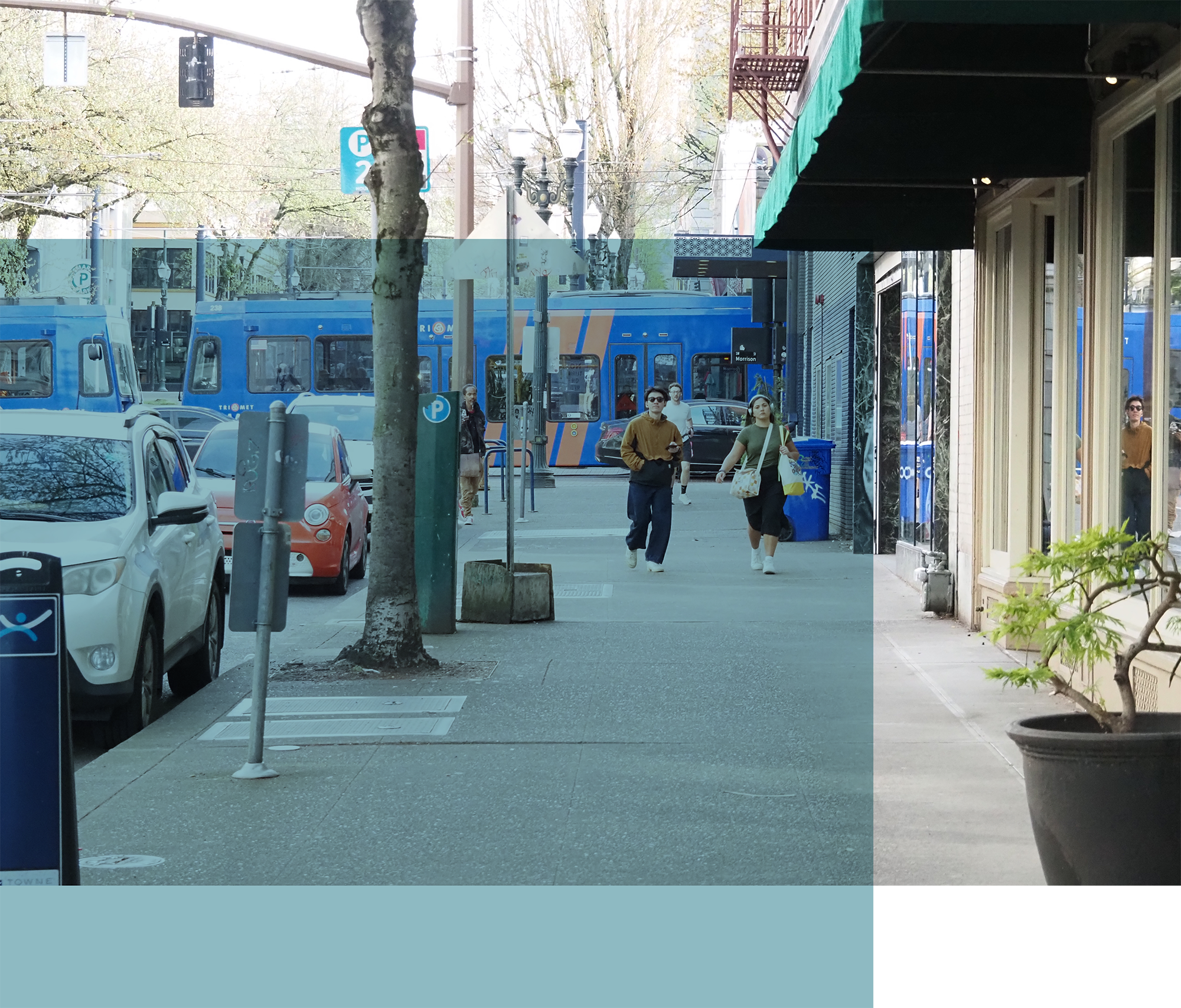
Field States finds the latent potential in cities and brings it to life.
Field States grew out of a simple question: How do cities learn?
Cities are living systems—markets, communities, bioregional ecologies. They are sensitive to change, but too often they are not built to adapt well. As the pace of change increases, traditional development, investment, and planning processes are unable to keep up. The result is visible all around us: stranded assets, from strip malls to offices to luxury mixed use towers without a purpose.
At Field States, we create the conditions for cities to learn, and as they learn—they thrive.
Our team merges urban and architectural design, technology systems, and development management into a unique capacity for adaptive urbanism. We are critical and creative, developing strong business cases with integrity, and substantiating them with a bias for action.
Field States is a Portland-based benefit company founded in 2021. We work with forward-facing building owners, public agencies, and institutions, moving projects from analysis through implementation.
Our Team

Matthew Claudel
FOUNDERMatthew is passionate about the intersection of cities, technology, culture, and innovation. He has a PhD in Advanced Urbanism from MIT, where his work focused on urban experimentation as it relates to civic value. He is the co-author of Open Source Architecture (Thames & Hudson) and The City of Tomorrow (Yale University Press), and has written peer reviewed journal articles and fiction. During the Covid-19 pandemic, Matthew was the Strategic Design Lead for Curative, a company that scaled rapidly to deliver tests and vaccines across the country. He was a Futures Fellow at the Purpose Foundation in 2021, and a Juror for the Canadian Federal Smart Cities Challenge in 2018. Matthew co-founded MIT’s designX program in 2016, where he was the Head of Civic Innovation and an instructor for four years. He was a Visiting Assistant Professor at University of Michigan’s Taubman School of Architecture, and is an Affiliate Faculty Member of Portland State University's Geography Department.

Simon Giles
CO-FOUNDERSimon is an experienced business leader with a career in senior executive leadership and strategy, focusing on urban innovation and development at the intersection of technology, sustainability, and urban planning. During his 20-year Accenture tenure, Simon founded and built the firm's global Cities practice, growing it to over $200 million annual revenue with 80+ city clients. As Global Managing Partner, he led multidisciplinary teams focused on business strategy, urban masterplanning, service design, and digital strategy delivery. His work includes large-scale, new-build cities and urban real estate development, often collaborating with MIT. He served as UK Managing Director for Tyréns.

URBAN DESIGNMora Orensanz
Mora Orensanz is an urban designer at Field States, where she is passionate about exploring the potential of design, from services to technologies, as a powerful tool for driving social and environmental impact in cities. Mora is co-founder of La Firme, a startup focused on improving housing quality for low and middle-income families in Peru through mortgage access and technical assistance. She has worked in large and small scale urban design projects in the US and Argentina, and most recently collaborated on a book titled The Equitably Resilient City: Solidarities and Struggles in the Face of Climate Crisis (Lamb & Vale, 2024), where she conducted in depth research and developed the visual strategy for the book. She studied Architecture at UNLP, Argentina, and holds a Master's in City Planning from MIT.

Kim Smith Claudel
DESIGNERKim Smith Claudel is an artist and designer in Portland Oregon. Her art practice intersects painting, sculpture, and performance while using a variety of natural, discarded, and technological media—often created within limitations or rule sets. Her work has recently been shown in Japan, Sweden, and across the US. She is a member of WAVE Contemporary artist collective as well as Carnation Contemporary Gallery. Her graphic design work spans illustration, brand identity, book design, and UI/UX design. She received an MS in Media Arts and Sciences from the MIT Media Lab, where she was a Learning Innovation Fellow. Her research in early childhood education led her to found the company Learning Beautiful, where she designs educational toys and experiences. She holds an MFA from the School of Visual Arts.
Collaborators

Bryan Boyer
Bryan is an architect, strategic designer, and technologist. He is the Faculty Director of the Urban Technology program at University of Michigan. He writes regularly on the topic of design, including the book Design for Social Innovation: Case Studies from Around the World published by Routledge in 2021. He is the cofounder of architecture and strategic design studio Dash Marshall. Bryan serves on the board of directors for Public Policy Lab in New York City and lives in Detroit, MI. He has a MArch from Harvard Graduate School of Architecture.
ARCHITECTOUR VALUESIntegrity
Our analysis is not shaped by a preferred outcome. It is grounded in our research-based framework and expertise, and it tells the truth about a place. Clients trust us with consequential decisions, and that trust builds the foundation for everything else.
Aligned Accountability
We succeed when our clients do. A portion of every analysis fee is credited toward the delivery work that follows, where fees are tied to delivery milestones. We are committed to every project we take on, and to the people and places that depend on its success.
Rigorous Optimism
Uncertainty is a condition, not an obstacle. We believe that underperforming assets, struggling districts, and cities under fiscal pressure have real potential, and that finding it requires both the analytical tools to see clearly and the conviction to act.
Curiosity
Clients choose Field States because they are facing complexity and need creative solutions. We begin every engagement with a question, not a predetermined answer. With curiosity, we hold space for discovery, letting new ideas emerge.
Reach Out
Let’s start a conversation.
Schedule an introductory conversation—an opportunity for our team to hear more about your context and share how Field States works.